
How to Build, Position, and Sell Premium Fiberglass Entry Systems
MASTERGRAIN is built for door manufacturers who want to compete beyond commodity steel and fiberglass entry systems or sell alternatives to premium wood doors that tend to be problematic after installation and over time. Whether the demand is coming through dealers, architects, builders, designers, or directly from homeowners, today’s premium projects increasingly require more than a standard slab and frame. They call for distinctive design, refined finishes, reliable performance, and a product story that helps justify an elevated investment. For pre-hangers, this creates an opportunity to move upstream by offering entry systems that feel more custom, more complete, and more aligned with the expectations of design-conscious customers. MASTERGRAIN supports that shift with a premium fiberglass product line, matching components, customization potential, and a brand platform that gives manufacturers the tools to pursue projects where differentiation matters.
For door pre-hangers, the ability to deliver a premium entry system depends on more than the panel itself. It depends on the accuracy, consistency, and care applied at every step of preparation. Panel and component machining is one of the most important parts of that process, because it directly affects fit, alignment, hardware function, installation efficiency, and long-term system performance. The following section outlines the key machining considerations behind a MASTERGRAIN door system and explains how proper preparation helps manufacturers build with greater confidence, consistency, and quality.
Panel Machining
Reducing Scrap: The Objective Driving Every Step
A well-dialled machining process is essential to protecting quality, reducing scrap, and preserving margin, especially on premium project work where each panel carries higher value. Because a mis-machined or damaged panel often cannot be reworked, the right equipment, tooling, training, and process discipline matter. For pre-hangers, this is less about adopting a single prescribed method and more about understanding whether their current setup is aligned to the level of accuracy and consistency premium fiberglass door systems require.
From Foam Injection to Machining
Every MASTERGRAIN slab is injected with 2.2 lbs/sq.ft of high-density polyurethane foam, forming a strong and stable core which then transitions into the machining phase where precision and consistency take priority.
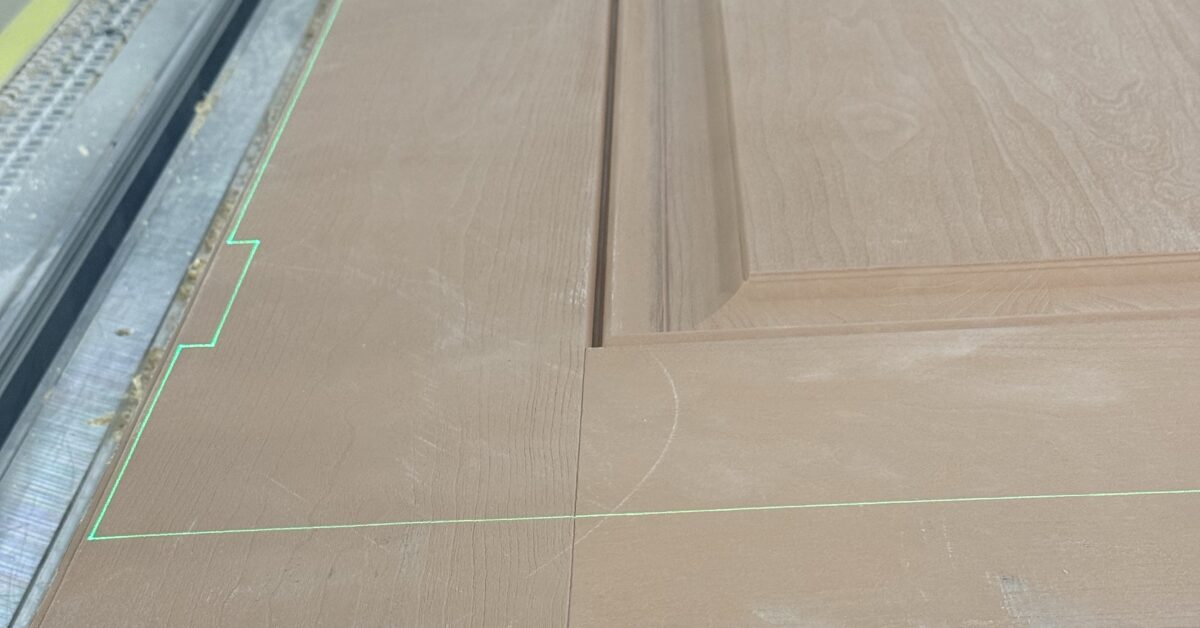
At this stage, MASTERGRAIN integrates advanced DXF laser projection to accurately register each slab on the machine bed. This ensures alignment based on the panel’s true geometry rather than nominal dimensions. By minimizing variability from the outset, the system enables precise routing, cutouts, and detailing while significantly reducing the risk of error and material loss.
From clamping methods and tool selection to programming strategy and panel sequencing, every element of the machining process is engineered to protect the integrity of the slab. This is why MASTERGRAIN invests in custom tooling, aerospace-grade software, and highly controlled processes.
Machining as One Solid Unit
One of the core principles at MASTERGRAIN is that each door is machined as a single, continuous unit. This is not simply a production convenience but a quality strategy. By processing every detail within the same setup and the same reference frame, the system ensures that if a panel completes all machining processes without issue, it will be dimensionally consistent with itself. Every hinge prep, lock bore, and cutout relates back to the same origin point.
For the pre-hanger, this matters enormously. It means the dimensions you are working to are not theoretical averages, they are the actual, verified dimensions of that specific panel, held in check by a process designed to minimize variability from the first operation to the last.
Aerospace-Grade Software: HyperMill in a Door Factory
MASTERGRAIN doors are programmed using HyperMill, the same CAM software used in the aerospace and precision engineering industries. HyperMill allows MASTERGRAIN’s team to program one-off door designs with the same rigour applied to complex machined components in high-stakes manufacturing environments. Each unique order can be translated into a precise, verified tool path before a single cut is made.
This level of software capability also means the process scales elegantly. MASTERGRAIN’s team handles a high volume of different door designs and HyperMill makes it possible to maintain accuracy across that variety without sacrificing efficiency and quality.
Aerospace-Grade Software: HyperMill in a Door Factory
Holding the Panel: Stability Before Precision
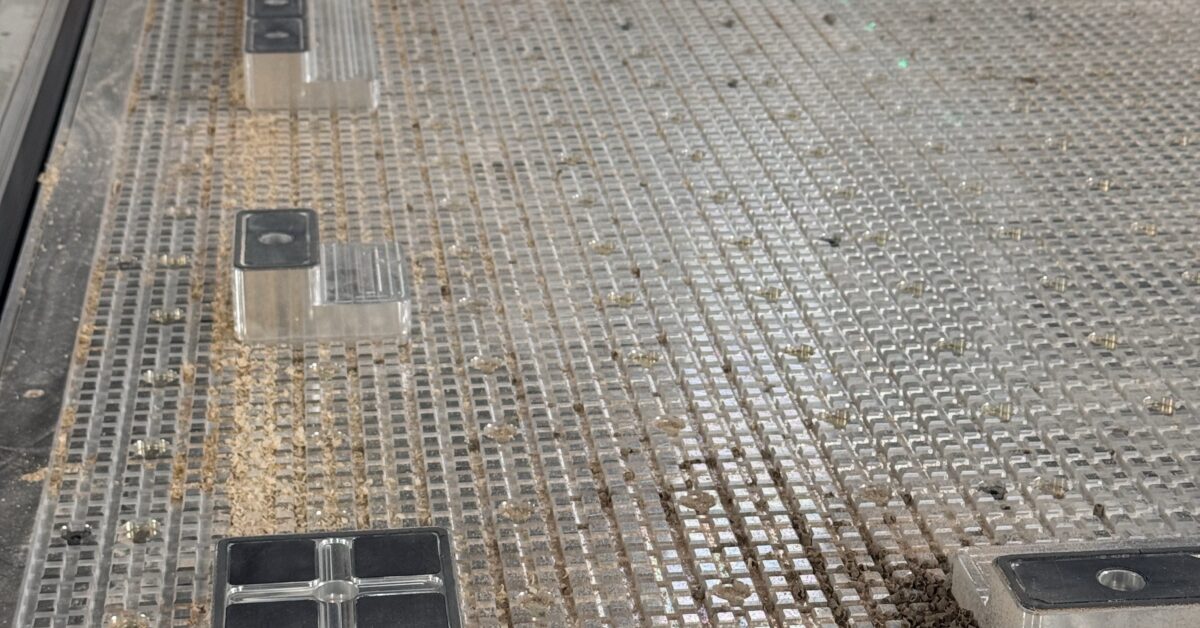
Accurate machining starts before the cutter touches the panel. The door first needs to be held flat, stable, and properly referenced so each machining operation remains true to the dimensions that matter. In MASTERGRAIN’s process, this is done using a vacuum table with custom standoff pucks designed to support the panel while keeping key machining areas accessible. The goal is not simply to keep the door from moving, but to reduce the small shifts, flex, or vibration that can lead to tolerance issues, rework, or scrap.
For pre-hangers, this is a useful point of comparison. Every shop will have its own equipment, workflow, and level of automation, but the underlying requirement is the same: the panel must remain secure and supported throughout machining. Whether that is achieved through vacuum, clamping, custom supports, or a combination of methods, the process should protect accuracy, repeatability, and ultimately profit margin. On premium project work, where each panel carries more value and replacement costs are higher, secure panel holding is not just a setup detail. It is one of the first quality gates in the manufacturing process.
Tooling and Sequencing: Protecting the Panel Before Finish
The cutting tool is another important point of comparison in any machining process. MASTERGRAIN panels have specific material characteristics, and the tooling used to machine them needs to support clean cuts, consistent edges, and repeatable results. In MASTERGRAIN’s own process, the team uses a combination of proven tooling and custom-developed tools where needed to improve cutting speed, edge quality, and consistency across different panel configurations.
Tool length, rigidity, and setup also matter. Longer tools can introduce more deflection, vibration, and variation at the cut, especially around hinges, lock prep, lite cutouts, or other precision details. For pre-hangers, the question is not whether every tool needs to be custom-made, but whether the tooling, setup, and programming are matched to the panel and the work being performed.
This same thinking applies to the order of operations. Whenever possible, machining should happen before finishing. Cutting into a finished panel can increase the risk of chipping, surface damage, contamination, or other cosmetic issues that are difficult to correct. On premium project work, where each panel carries more value, sequencing becomes part of margin protection. The goal is simple: complete the higher-risk machining steps before finish is added, so the final surface is protected as much as possible.
Edge Sanding, Beveling, and Inspection
Once machining is complete, panels move through a defined post-machining sequence before entering the finishing stage. First, they pass through an edge sander to clean up and refine cut edges. Beveling follows, ensuring the door profile meets specification. Then comes a thorough dimensional inspection — a checkpoint where critical measurements are verified before the panel proceeds to tape prep.
This inspection step is the mechanism by which MASTERGRAIN confirms that the machining process has delivered what it promised and catches any anomalies before they are built upon by subsequent operations.
Understanding the Factory Finish
There’s a moment every salesperson knows well: a homeowner leans in toward a MASTERGRAIN showroom door, studies the grain, and asks, “Wait — is that actually wood?”
That reaction is not an accident. It is the result of a factory finish system designed to bring out the depth, realism, and character of the MASTERGRAIN door skin while giving pre-hangers and dealers a consistent premium product they can stand behind.
Every MASTERGRAIN factory-finished door is built up through a deliberate finishing process that includes premium paint or stain, protective topcoat, rigorous performance testing, and the skill of experienced finishing technicians. The result is more than a beautiful door. It is a finish system that helps reduce field variability, supports product consistency, and gives the entire channel a stronger quality story to share with customers.
It Starts with the Surface
Real wood has open pores. The grain literally drinks in pigment, which is why a hand-wiped stain on wood looks the way it does. Fibreglass is non-porous. To get a convincing wood appearance on a fibreglass door, the finish system must simulate what wood does naturally. That’s the central engineering challenge the MASTERGRAIN team has spent years solving by using proprietary NVD technology that replicates every detail of real wood on fiberglass.
The Three-Layer System
Every MASTERGRAIN door goes through three distinct finishing stages.
Layer 1: The Base Coat
The base coat is colour-specific. Each stain colour in the MASTERGRAIN lineup has its own formulated base — not a generic primer that gets tinted, but a purpose-built coating matched to the final finish. It is spray-applied to create the foundation colour beneath everything that follows.
Think of it as the background note in the wood’s tone. A lighter finish, such as Tea with Milk or Sweet Honey on natural oak, begins with a warm base that supports a soft, golden character. A deeper finish, such as Brew or Bridle on cherry or mahogany, starts with a richer base that gives the final stain more depth, warmth, and brown undertones. The base coat establishes the starting point before the grain character, hand-applied stain, and protective topcoat are added.
Layer 2: The Hand-Applied Water-Based Stain
This is the layer that does the visual heavy lifting — and it is done entirely by hand.
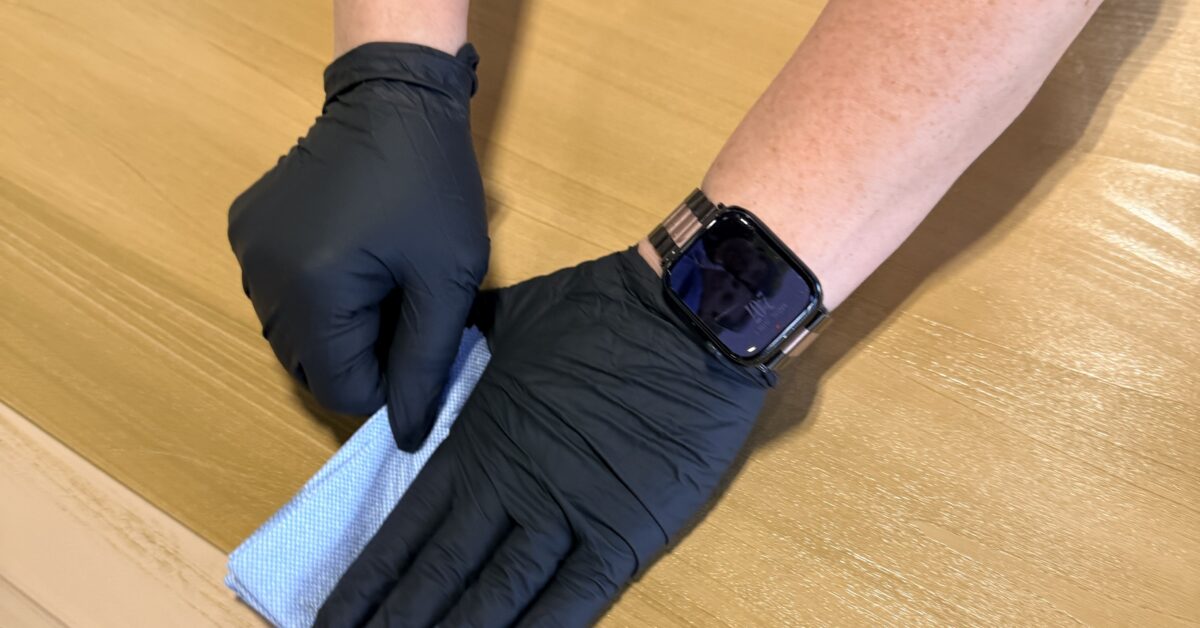
The water-based stain is applied with a sponge across the door surface and then carefully wiped back with a cloth, much like staining a piece of real wood. The key is what happens inside the embossed grain texture. The stain settles into the valleys of the grain pattern, collecting in a way that mirrors how pigment gathers in real wood pores. The raised areas are wiped cleaner, creating the contrast between light and shadow that the eye reads as genuine wood grain.
Calling it hand-applied is not marketing language. It is a description of the actual process. A person applies the stain, works it into the texture, and removes the excess by hand. Staining time varies depending on door complexity: simpler doors may take around 15 minutes, while more intricate profiles can take up to 40 minutes, with an average of approximately 30 minutes per door.
Because of that variability, MASTERGRAIN keeps the process tightly controlled through consistent tools, materials, techniques, and visual checks against a master sample. That discipline helps prevent colour drift across a production run or between doors on the same jobsite.
Layer 3: The Topcoat
The topcoat is the performance layer. Once the stain is locked in, the topcoat seals the door and gives it the durability it needs to survive production, shipping, handling, installation, and years of happy greetings for the homeowner.
This is where the engineering becomes measurable.
The Curing Process
After the stain is applied and colour-checked against the master sample, doors move into an infrared (IR) oven for 6 to 7 minutes. This rapid, controlled bake sets the stain before the topcoat goes on. Once cooled and verified for colour accuracy, the topcoat is applied and baked again through the same IR process. The result is a fully cured, factory-finished surface.
One variable worth knowing: water-based stains are sensitive to humidity. In more humid conditions, drying times extend before the door can enter the oven. It’s important that the finish team monitors environmental conditions as part of the process.
How Performance Gets Tested
Every production run is then subject to three standard tests:
Scratch Resistance — The surface is tested against scribing and abrasion to confirm the coating holds up to the kind of contact a door sees during delivery, installation, and everyday use.
Hardness Testing — A pencil hardness test (a standard coating industry method) confirms the cured topcoat has reached the target film hardness.
Adhesion Testing — A crosshatch adhesion test verifies that the topcoat is properly bonded to the stain and base coat below it. A finish that looks great but lifts at the edges isn’t a durable finish.
These tests are run as ongoing quality checks to ensure that what leaves the factory performs the same way once installed.
Why Water-Based Stains?
If you’ve worked with oil-based stains and finishes in the field, you already know the smell. That smell is volatile organic compounds (VOCs), the solvents that carry the finish off the brush and into the air as the coating dries. Prolonged exposure to high-VOC finishes is a legitimate occupational health concern.
MASTERGRAIN uses water-based products for both the stain and topcoat, which significantly reduces VOC emissions compared to oil-based equivalents. For the finish team at the factory, that matters every single day — people are working in close proximity to these coatings across full production shifts. Lower VOCs mean better air quality, less reliance on respiratory protection, and a healthier working environment overall.
The Consistency Challenge (And How It’s Solved)
Hand application introduces a variable that machine application doesn’t: the human hand. Two people applying stain can produce slightly different results if the process isn’t locked down. MASTERGRAIN addresses this at multiple levels.
At the tooling level, the specific applicators, wiping materials, and application sequence are standardized. At the quality level, every door is checked against a master sample before it moves to the topcoat stage. And at the training level, achieving consistent colour matching requires significant practice.
This matters when you’re hanging two or three MASTERGRAIN doors of the same colour in the same project. Consistency in the factory translates directly to consistency on the jobsite.
What This Means for Field Handling
Understanding how the finish is built should change how you handle a MASTERGRAIN door on site:
Each finish layer — base coat, stain, and topcoat — is factory-applied, IR-cured, and performance-tested. Field handling should focus on preserving this pre-finished system.
While the topcoat is engineered for durability, it is not impervious to damage. Scratch resistance does not eliminate the need for proper handling. Doors should be edge-protected during transport, kept off the ground, and shielded from contact with tools or abrasive surfaces.
Field touch-ups to the stain layer are not recommended. The stain is hand-applied under controlled factory conditions and matched to a master standard; attempts to replicate or blend it on-site will not achieve a consistent result.
For routine cleaning, use mild soap and water. Standard dish soap is sufficient for removing surface dirt without compromising the finish. Avoid abrasive cleaners or solvent-based products.
The Bigger Picture
MASTERGRAIN’s finishing process is one of the less visible — yet most critical — elements behind the product’s performance and visual appeal. The authentic woodgrain aesthetic that distinguishes each door is the result of a controlled staining system designed to behave like a true wood stain: flowing, settling, and contrasting in response to the engineered texture of the panel.
Achieving this level of realism on a non-porous substrate requires more than a high-quality coating; it demands an integrated, repeatable process. MASTERGRAIN combines advanced material science, precise application methods, and controlled curing technology to ensure that every door delivers consistent colour depth, grain definition, and finish durability across high production volumes.
Understanding this intersection of aesthetics and technology is key to representing the product accurately. A clear grasp of what goes into the finish enables proper specification, informed handling, and greater confidence when presenting MASTERGRAIN doors to customers who expect both performance and visual authenticity.
MASTERGRAIN as Your Training Partner
Understanding MASTERGRAIN’s machining process is the foundation for building complete, high-performing door systems in the field. When you know how a panel was made, you can make better decisions about how to handle, prep, and hang it.
MASTERGRAIN’s support team is available to work directly with prehangers to translate this manufacturing knowledge into practical on-site capability. Whether you are setting up a new shop operation, optimizing an existing process, or working through a specific production challenge, MASTERGRAIN brings the same depth of process expertise to the partnership that it applies to its own factory floor. The goal is simple: to equip every prehanger with the confidence and knowledge to build complete MASTERGRAIN systems to the highest standard.
If you'll be at the World Millwork Alliance Convention in Orlando Sept 14-16, 2026, MASTERGRAIN will be there.
We’d welcome the chance to walk you through our products and talk about what a partnership could look like for your shop.
Click to Book Time with our Team